Simple Fare for Simple Folk

Keeping it simple was a our motto for the day. You might say a lot of things about O Cantinho in Celorico but you’d have to agree that ‘simple’ sums it up.
We’d been detained in Mota for a while on mundane medical business and the thing about Mota is that you always feel the need to get decontaminated after spending even a short time there. If it wasn’t for the fact that that is where our medical centre and nearest shops are then I’m sure we’d never go. It’s basically a couple of blocks of very ugly buildings situated in some pretty countryside and it sucks the life out of you, even if the new doctor shaking her head over your heart monitor results hasn’t already done that. So, off for a reviving lunch somewhere remarkably uncomplicated, please. That immediately rules out the grill house in Mota itself because 1) it’s in Mota and 2) they have a reputation for being very rude to customers. We also forego having lunch down the road near Arnoia Castle, not least because the restaurant there is called A Forca – the Gallows - and we go the extra kilometre or six to get to Celorico. For a reason I simply cannot my finger on, Celorico always cheers me up, no matter what the weather – even if we’ve gone in to visit the town hall to sort out some of the paperwork that Portugal delights in needing to be sorted out at regular intervals.
So, it’s with a smile on our faces that we cross the footbridge over the little river, which is unimaginatively called Rio da Vila but which is a delight to behold from the bridge, the waterwheels on the restored mills splashing away in the autumnal sunlight. A short hop and a skip and we arrive at O Cantinho, which means The Little Corner and has nothing to do with canteens. In fact, I can never quite decide what the eating-house status of this establishment actually is for it seems to be a basic tasca which aspires to fine dining while actually managing to be neither. We’ve lunched here a number of times before and I’m sure that the same four old men were sitting alone at the same four tables on the previous occasions. Then, as now, they were methodically slurping their way through large bowls of soup, their eyes fixed on their bowl and not straying to take in any of the rest of the restaurant or its occupants. After the soup, they quietly shuffle away from their places, two of them with walking sticks and one sighing deeply. I decided that they were ancient widowers and that the owners of the restaurant had taken pity on them and offered them a daily bowl of soup on condition that they arrive early and leave quietly. I could always ask the people who run the restaurant but that risks hearing a much more mundane story, so I keep quiet.
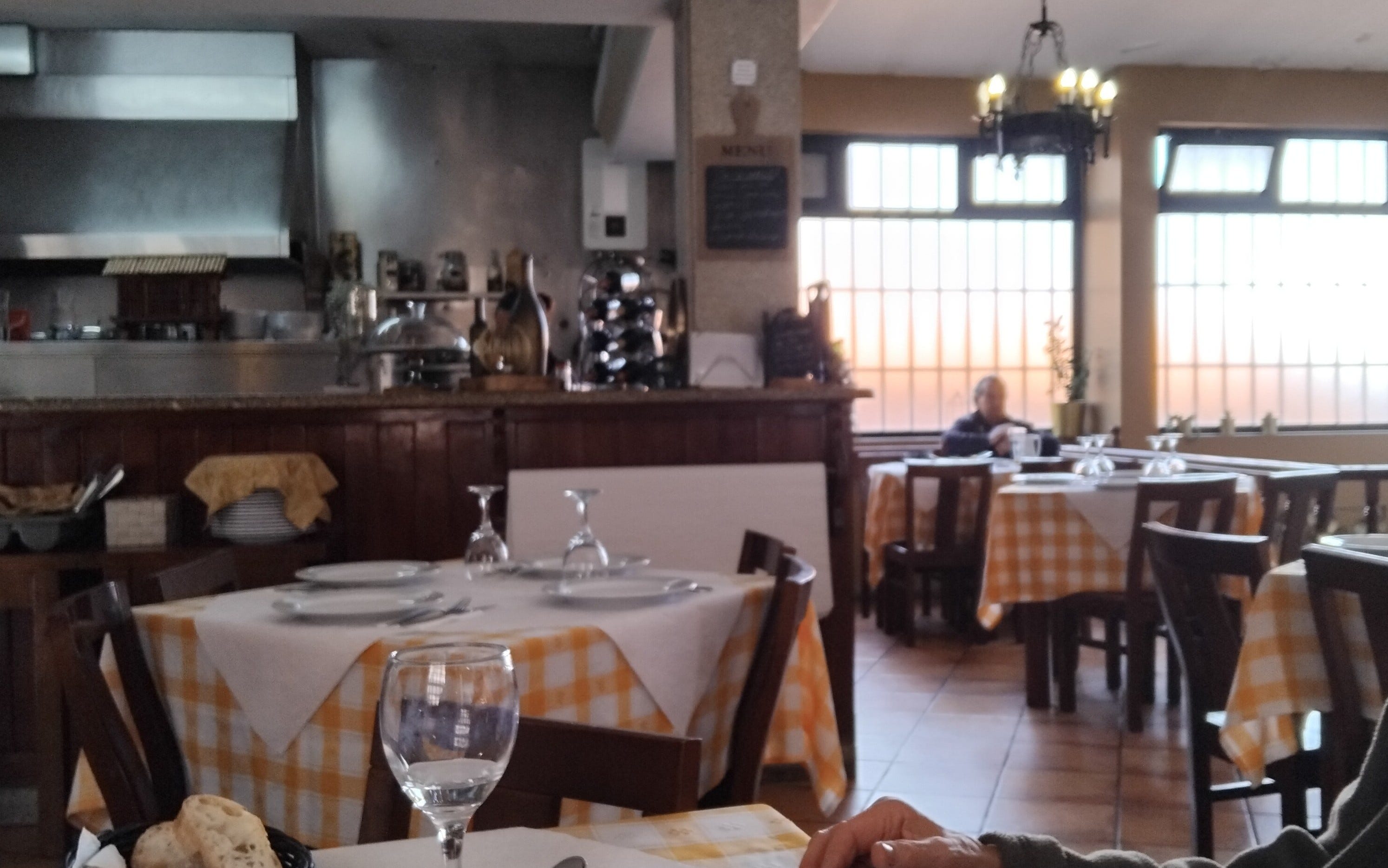
The building is a fine old granite block set on the corner where the main road through the town and the old road from Arnoia meet, and close to the river. It’s dark and old fashioned inside and even the windows are the old small pane wooden frames which you have to slide up or down to open or close. We talk about that and I warble on about sash cords and the eyes of the missus glaze over.
The lunch menu is simple and, like all good menus, verbal only. Caldo Verde is the soup and we hungrily devour a bowl each and I instantly understand why the old men focussed entirely on the bowls in front of them for it is very good soup indeed and deserves our full attention. The main course is arroz de pato – duck rice – and that too is exceptionally good. Nothing fancy or tricky, just old fashioned cooking done very well. As we are finishing, a large group of friends turn up and a cluster of empty tables near to us are pulled together. A good time to pay up and leave. Sixteen euros for the two, including drinks and coffee and I remember another reason why we come here for lunch from time to time.
We walked back to where we’d parked the car outside the school by strolling though the little park where the watermills gurgle. Autumn in all its splendour lay at our feet. Simple joys, you see; simple joys.

Back in 1970 I remember someone was trying to program a computer to ‘speak’ words typed into it. For some reason, the experimenter put in the sentence “I prefer the simple life”, and the gadget produced “I prefer the sinful life”. Its monstrous, AI, great-great-great grand, er, children(?) are possibly on the cusp of ‘understanding’ the difference and inciting the susceptible to choose the wicked path to termination. Except, it seems, in Celerico, where, as in Asterix’s Gaulish village, the old-fashioned wet, warm, human intelligence (and tasty caldo verde) will prevail. I hope your simple reports will continue for many heartening sequels.